
- THE SOFA STYLING GUIDE
How to Style Your Sofa with
Affordable Cushions & Throws
The sofa is the most-looked-at surface in your living room. This is how to dress it like a designer — using cushions that cost less than a dinner out and throws you can find at any market.
₹800
FULL STYLING BUDGET
1 Hr
TIME TO RESTYLE
0
TOOLS REQUIRED
-Why this matters
Your sofa and cushions are speaking. Make sure there are saying
something intentional.
A sofa does not just provide seating; rather, it sets the tone for your entire room. In fact, when a guest walks in, their eyes naturally land here first.
“A sofa styled with intention anchors an entire room. A sofa styled with anxiety fills it.”
— Ramya, Loamlet
-THE DESIGNERS' FORMULA
Three rules. Every well-styled sofa follows all of them.
These aren’t preferences — they’re the structural logic behind every sofa you’ve admired in a magazine and couldn’t quite explain why it looked so right.
Odd Numbers
Specifically, stick to three or five cushions. Even numbers create a showroom vibe, whereas odd numbers feel like a home.
Sizes
The 60-50-30 rule. Large anchor, medium layer, and one small lumbar accent.
Texture
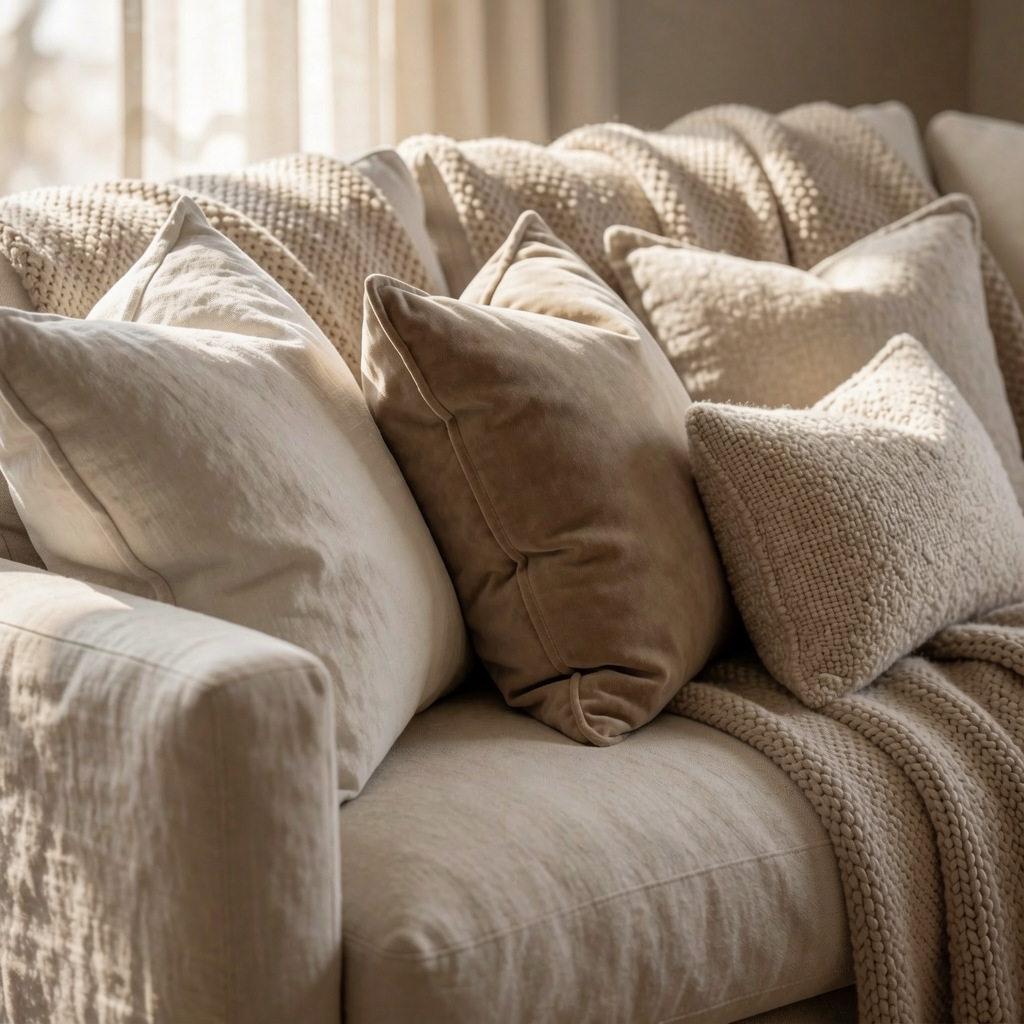
Linen, velvet, and one knit. Keep it to three to avoid visual noise.
-FABRIC CHOICES
The fabrics that always look
more expensive than they are.
Fabric is where the designer-look lives. Getting this right costs almost nothing — and getting it wrong costs you the whole effect.
-THE FABRIC SHORTLIST
What to buy,
and what to leave on the shelf.
Not all cushion fabrics are equal in how they photograph, drape, and age. These four are the ones worth spending on — and the last two are the ones to avoid regardless of price.
- Linen & cotton slub— The base of every good cushion arrangement. Lightweight, breathable, and it gets more beautiful with use. Never needs ironing; the natural creases are the point.
- Velvet— Adds depth and richness at a price point that always surprises. Even a single ₹350 velvet cushion cover elevates an entire sofa arrangement. Avoid the shiny polyester versions — look for a matte, crushed finish.
- Chunky knit or handwoven— The texture accent. One is enough. Its job is to introduce organic irregularity into what might otherwise read as too composed.
- Avoid: printed polyester— Photographs flat, feels cheap against skin, and pills within weeks. The pattern is never worth the material compromise.
-PATTERN MIXING
The one rule that makes pattern work every time.
Mixing patterns is what most people are afraid of — and the fear is understandable, because when it goes wrong it goes badly wrong. But there is one principle that makes it almost impossible to fail, and once you know it, you’ll use it every time.
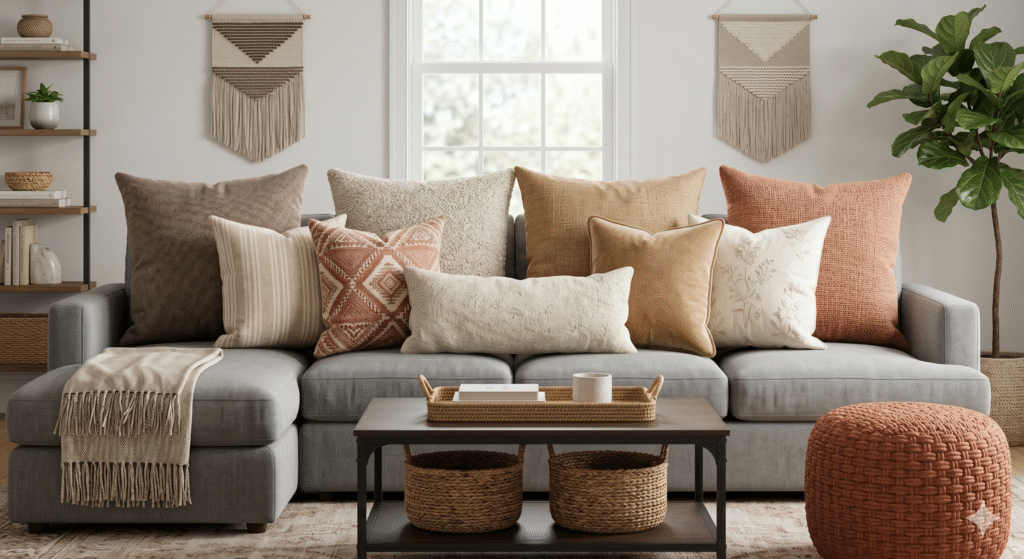
- Vary the scale, not the family.A large geometric with a small geometric. A wide stripe with a narrow check. Keep the patterns in the same visual family, but change how large they are. The contrast in scale reads as intentional variety; the shared family reads as cohesion.
- One pattern per sofa is also correct.Two or three solid textures with one patterned accent is a perfectly valid — and often more elegant — approach than three patterns fighting for attention.
- Florals and geometrics rarely coexist.They come from different visual languages. Mixing them requires a very confident hand — and if you have to think about it, the answer is probably to choose one.
- The 70/30 rule:70% solid or textured, 30% patterned. Never let pattern dominate. It’s the supporting character, not the lead.
-THE INTERACTIVE TOOL
The Cushion Palette Builder
Select your sofa colour and styling preference — the tool generates a complete cushion palette with recommended fabrics, ratios, and a visual preview. No guesswork.
The Cushion Palette Builder
Your Cushion Palette
-THE THROW
Three ways to drape a throw -
each one does something different.
The throw is the most versatile element on your sofa. How you drape it changes the entire mood of the arrangement — not just decoratively, but psychologically. Here are the three techniques worth knowing.
TECHNIQUE No. 1
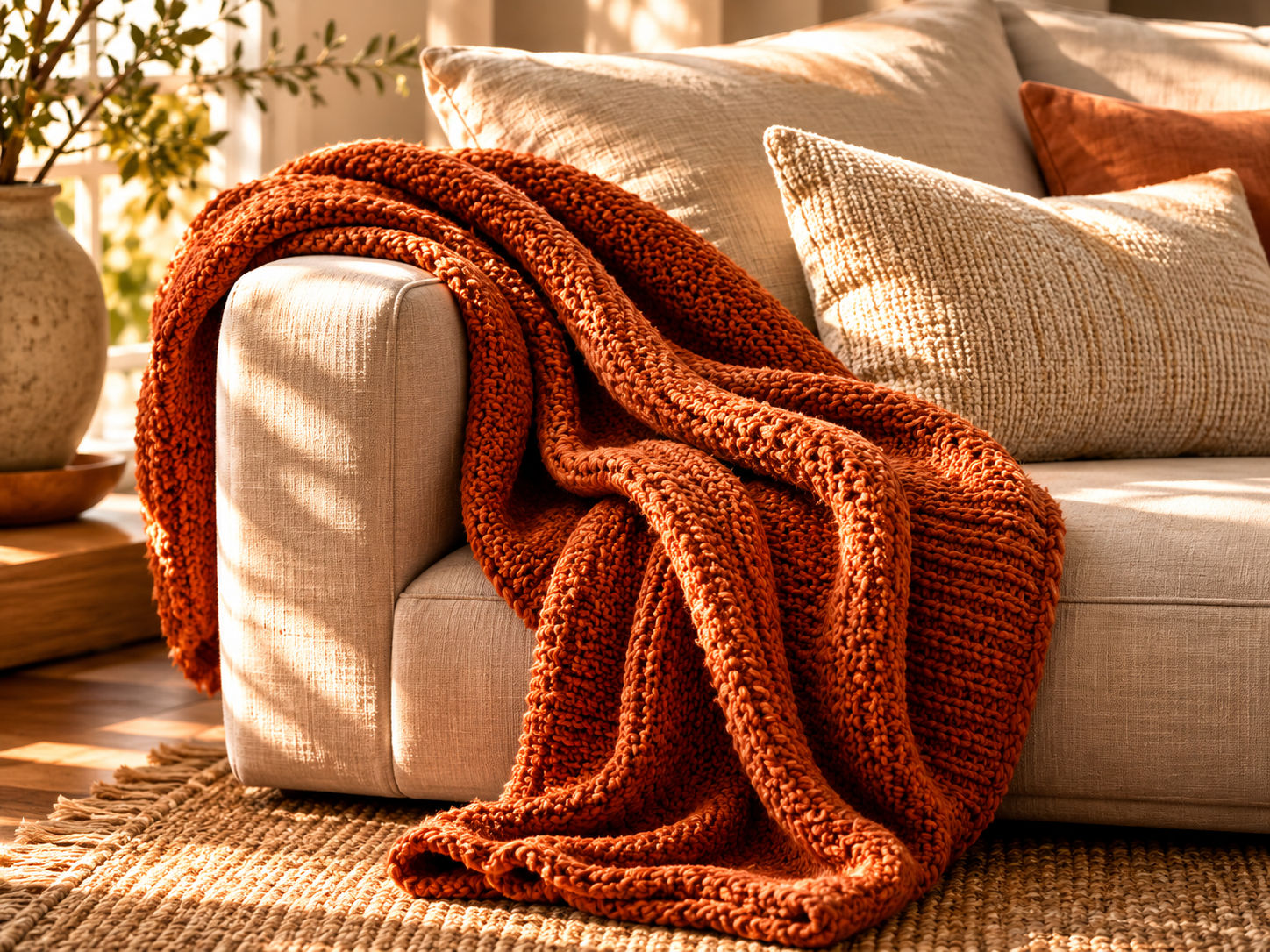
The Arm Drape
Fold the throw loosely in thirds lengthwise and lay it over one arm of the sofa, letting it pool slightly at the base. This is the most casual technique — it communicates ease and comfort. Best for chunky knit or textured weave throws where the material itself is the visual point. Never fold it too neatly; a slight asymmetry is what makes it look natural rather than staged.
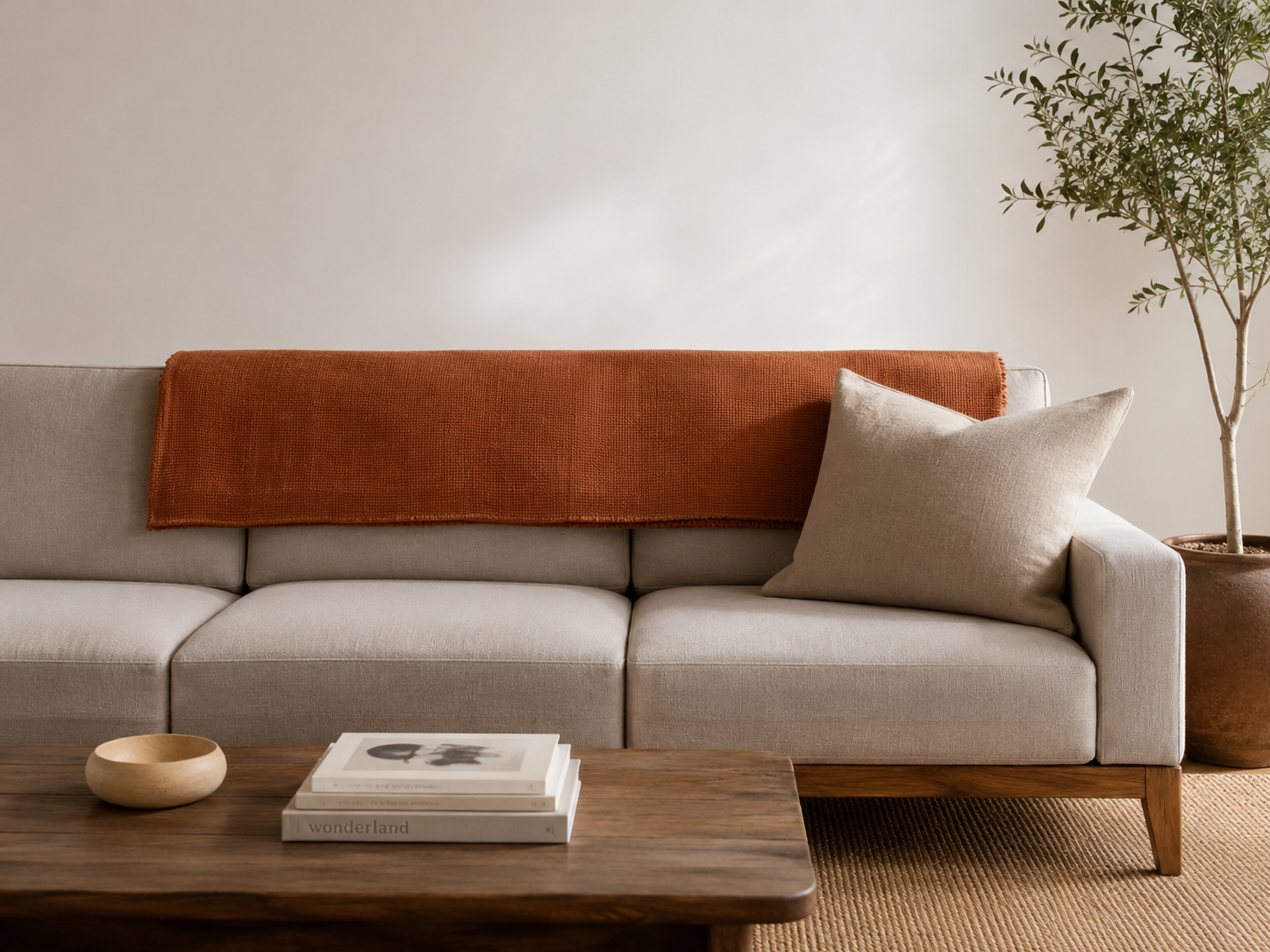
The Back Drape
Fold the throw into a wide, flat rectangle and drape it horizontally along the back of the sofa. This technique adds a band of colour or texture at the top of the arrangement — it reads as more intentional and editorial than the arm drape. Works best with flat-weave or linen throws where the neat edge is part of the effect. Tuck the ends slightly under the cushions to anchor it.
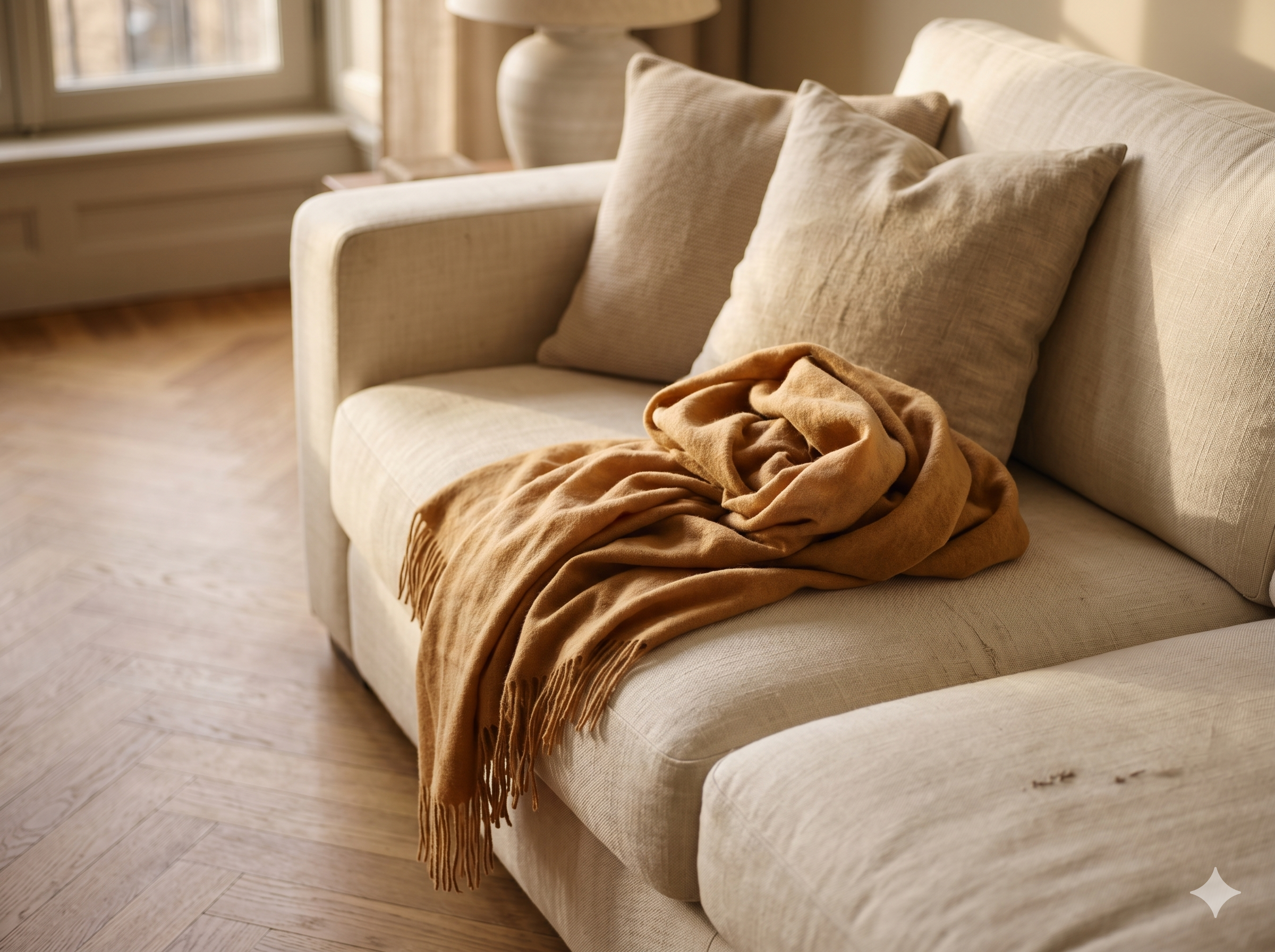
TECHNIQUE No. 3
The Corner Pool
Fold the throw loosely and leave it gathered in one corner of the sofa seat, as though someone just set it down after use. This is the most lived-in, inviting technique — it says the room is actually used. Resist the urge to make it too perfect. The slightly tumbled quality is intentional. Best with lightweight or cashmere-style throws where the soft fall of the fabric is the detail.
Everything you need, under
₹800.
A complete sofa restyle with five cushion covers, one throw, and two inner pads — broken down by what to buy first if your budget is tighter than ₹800.
| Item | Where to Find It | Est. Cost | Priority |
|---|---|---|---|
| 2 × Large linen cushion covers (60×60 cm) Natural, undyed linen or cotton slub |
Fabric markets, H&M Home, Ikea | ₹280–400 | Essential |
| 1 × Velvet cushion cover (50×50 cm) Matte finish, deep colour (terracotta, green) |
Pepperfry, local stores | ₹150–350 | Essential |
| 1 × Chunky knit or woven throw Neutral or complementary colour |
Ikea, Amazon India | ₹300–500 | Essential |
| 1 × Textured lumbar cushion (30×50 cm) Woven, knit, or embroidered |
Craft markets, Jaypore | ₹120–250 | Nice to Have |
| Complete Restyle Total | ₹850 max |
What to avoid — and the precise fix for each one.
1. Using an even number of cushions
THE FIX
Remove one cushion. If you have four, go to three. If you have two, add a lumbar or small accent. Odd numbers, always.
2. All cushions the same size
THE FIX
Introduce at least two sizes. One large (60×60) at the back, one standard (50×50) in front, one lumbar or small square as the accent.
3. Under-filled cushion inserts
THE FIX
Buy cushion inserts one size larger than your cover, or fill existing inserts with extra stuffing. A 50×50 cover should have a 55×55 insert. The slight tension creates the plump, full look.
4. Too many competing patterns
THE FIX
Keep 70% of cushions solid or textured. One patterned accent is usually the right amount. If you love pattern, vary the scale drastically so they don’t compete.
5. A throw folded too neatly
THE FIX
Fold loosely, not precisely. Allow one or two edges to be slightly uneven. Drape rather than place. The imprecision is the point — it says this room is genuinely lived in.
6. Ignoring the sofa colour entirely
THE FIX
Use the Cushion Palette Builder above. Always start from your sofa colour and work outward, not the other way around.
Frequently Asked Questions
1) How many cushions should I put on a sofa?
For most sofas, three to five cushions look balanced without making the seat feel crowded. A small sofa usually suits three cushions, while a larger sofa or sectional can take five. Odd numbers tend to look more relaxed and natural than even-numbered arrangements. Joss & Main My Homier Home
2) What size cushions look best on a sofa?
A good starting point is larger cushions at the back and smaller ones layered in front. For a standard sofa, back cushions around 22 to 24 inches work well, then step down in roughly 2-inch increments for the front layer. This creates a fuller, more intentional look. My Homier Home Studio McGee
3) How do I mix and match sofa cushions without making them look messy?
Start with a simple color palette of about three to five colors, then mix sizes, shapes, and textures. Combine one organic or softer print, one more geometric pattern, and at least one solid or textured cushion so the arrangement feels layered rather than chaotic. Varying pattern scale also helps the mix look designer-styled. Style by Emily Henderson Studio McGee
4) What colour cushions go with a grey sofa?
Grey sofas work well with both neutrals and accent shades. For a soft look, try beige, tan, cream, or layered greys. For more contrast, mustard, rust, blue, green, or pink can work beautifully depending on the sofa’s undertone. If your grey leans cool, blues and greens feel cohesive; if it leans warm, rust and earthy tones are often better. The Spruce
5) What colour cushions go with a beige sofa?
Beige sofas are easy to style because they pair well with warm earthy tones, cool blues and greens, and even a stronger pop like pink or yellow. If you want a calm, timeless look, add texture through linen, velvet, or woven fabrics rather than relying only on bold color. Castlery
6) What size throw blanket is best for a sofa?
A standard throw blanket for a sofa is usually around 50 x 60 inches. If you have a larger sofa or sectional, a 60 x 80 inch throw gives better coverage and looks more generous when draped. In2Green
7) How do I drape a throw on a sofa so it looks stylish?
The easiest ways are to drape it loosely over one arm, fold it flat across the back, or gather it casually into one corner of the seat. A slightly imperfect drape usually looks more relaxed and more designer-like than a very stiff, symmetrical fold. Source
8) How can I style a sofa beautifully on a budget?
Focus on a few key pieces instead of overbuying. Start with two large neutral cushion covers, add one accent cushion in a richer texture or color, and finish with one throw. Your post already supports this angle well with a budget-led restyle plan and a clear buy-first priority list. Source
“The best-styled sofa in the room is almost never the most expensive one. It’s the one where everything was chosen.“
— Ramya, Loamlet
You’re ready
Style your sofa this weekend.
You now have the formula, the fabric shortlist, the palette, the draping techniques, and the shopping guide. The only thing left is to start.