
The Long Game.
Steel or wood? The modular kitchen conversation used to end at plywood. A quieter revolution in materials — and a longer view of ownership — has begun to change the answer
By Ramya
Materials, Interiors
Seven minutes
05 July 2026
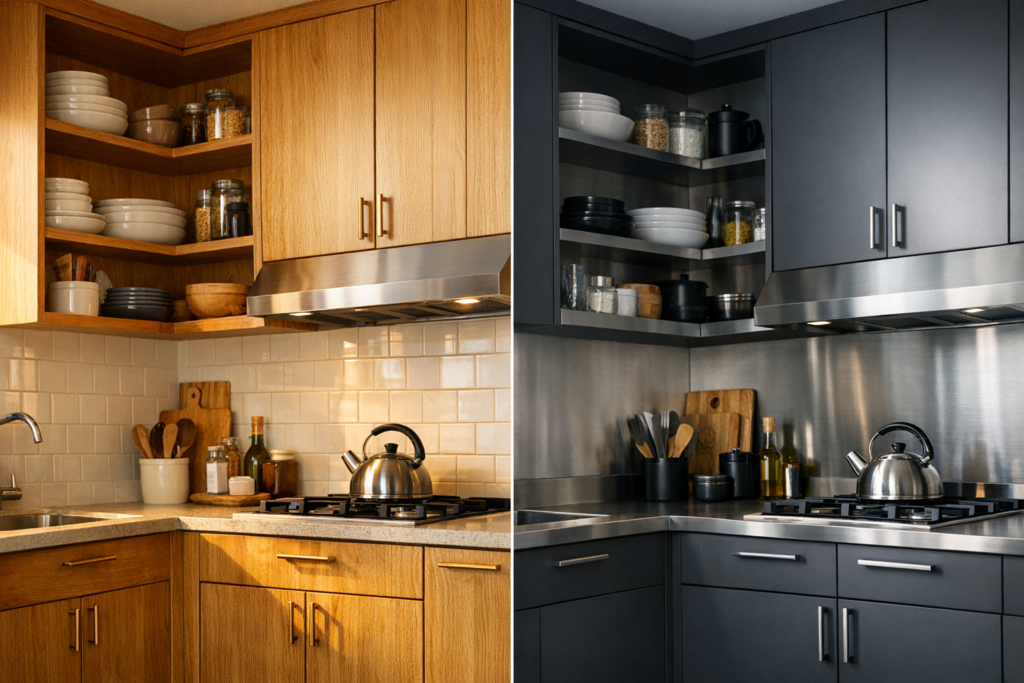
The kitchen is one of the few rooms in a home that is used, wet, heated, and scrubbed several times each day
For decades, the modular kitchen conversation began and ended with wood. Plywood, MDF, particle board — these were the default materials, and the only real question was which laminate or veneer would sit on top. Walk into a design studio today and the vocabulary has shifted toward termite proof modular kitchen materials: metal carcasses, aluminium profiles, and stainless steel units that promise to outlast the house itself.
The shift is more than aesthetic curiosity. It is driven by a very practical tension: the pull between what is cheapest to install today, and what actually costs less to own across fifteen or twenty years. What follows is an honest comparison — where the money goes, what you get for it, and which choice makes sense for the long haul rather than the housewarming photographs.
I. Durability, and the search for termite proof modular kitchen materials.
Every Indian kitchen has two constant adversaries: water, and pests. Materials are separated by how they respond to each.
Wooden modular kitchens — whether built from plywood, MDF, or HDF-HMR boards — are fundamentally organic. Even the best marine-grade or BWP plywood is treated wood, and treated wood is still wood at its core. Under a leaky sink, near a dishwasher, in the humid pocket beneath a water purifier, moisture eventually finds a way in. The board swells, delaminates, and loses structural integrity. A well-made plywood kitchen realistically holds ten to fifteen years before the wet zones show their age.
When evaluating termite proof modular kitchen materials, steel and aluminium flip this equation entirely. Stainless steel is waterproof by nature and immune to termites, borers, and fungal rot. A well-constructed stainless steel kitchen can realistically serve twenty-five to thirty years or more, with almost no material degradation. Spills wipe away, humidity is irrelevant, and there is simply nothing for insects to feed on.
• Wood
Organic, warm, familiar — and mortal.
• Steel
Cool, inert, quietly permanent.
The honest caveat: steel is not flawless. It can dent under a hard impact, cheaper grades may show water spotting if not properly finished, and a brushed or matte surface reveals fingerprints more readily than a laminate. These are cosmetic quirks — not structural collapse.
" Cheapest and best value are not the same word. "
– On the true cost of ownership
II.
Where the real money lives.
In a modern modular kitchen, the mechanisms hidden inside the cabinets often cost as much as — or more than — the cabinets themselves.
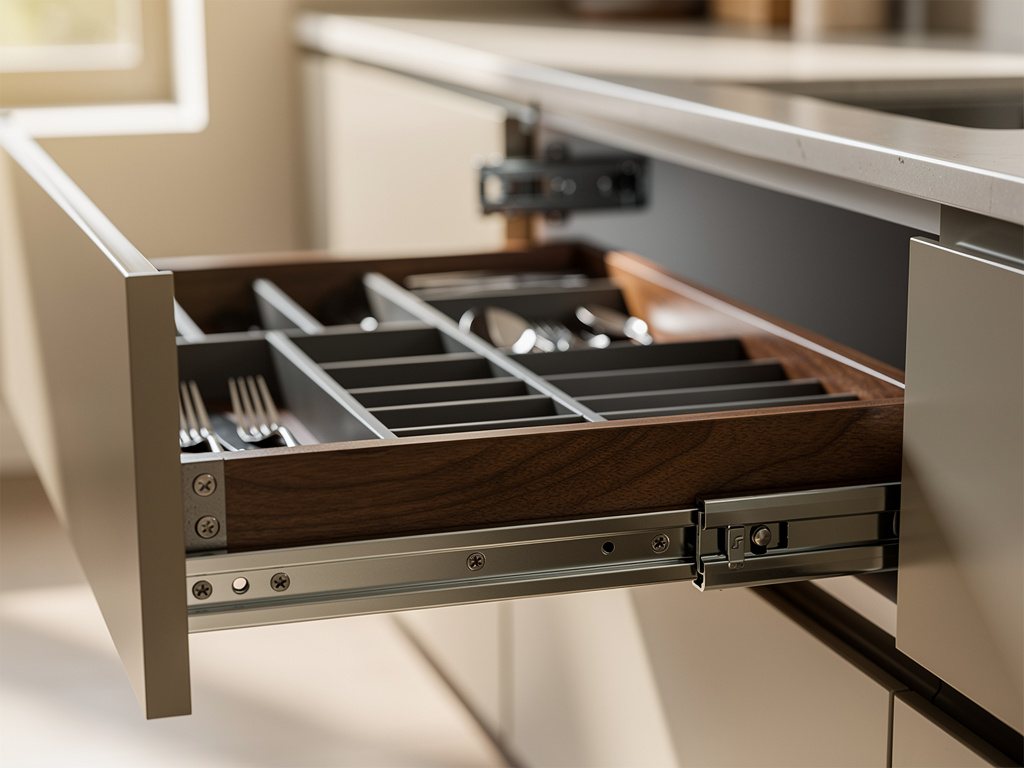
FIG. 02 Soft-close hinges, telescopic runners, and pull-out mechanisms — the quiet luxuries.
High-quality internal hardware is largely material-agnostic in cost. A soft-close drawer runner costs what it costs, whether it is screwed into a plywood carcass or a steel one. Compared like-for-like, the hardware portion of a wooden and steel quote comes out broadly similar — which is why the assumption that “steel is expensive” tends to collapse the moment specifications are matched.
There is, however, a meaningful technical difference. Metal carcasses hold screws and fixings extremely well, and do not lose their grip. In wooden kitchens, screw points that anchor heavy hardware can loosen or strip as the material ages or absorbs moisture — a drawer that sags, a hinge that pulls loose. The expensive mechanism keeps working. The wood around it does not.
III.
The true cost, spread across a life.
Upfront cost and true cost are not the same number. Consider what you actually spend over twenty years.
Wood is cheaper on day one.
Then, quietly, it isn't anymore.
Where each material earns its keep
Upfront cost
LOWER IS BETTERDurability
RESISTANCE TO WATER, PESTS, WEARMaintenance
EFFORT & COST, ONGOINGLifetime cost
AVERAGED PER YEAR OF USESo - which is right for you?
If your horizon is short, and your kitchen stays dry — wood remains an honest choice.
Choose wood if you are working with a firm short-term budget, renovating a home you may not keep for the long term, or the space is genuinely dry and low-risk.
Good plywood with quality hardware is a perfectly sound, attractive choice, and the lower entry cost is a legitimate advantage. Insist on BWP-grade board in wet zones. Do not compromise the carcass to save money.
If your horizon is long, and your kitchen sees heavy use — steel is the true budget choice.
Choose steel if you are building for the long haul, your kitchen will see heavy daily use, or you live in a humid or termite-prone region.
The higher initial spend buys you decades of near-zero maintenance and protects the expensive internal hardware you are paying for anyway. For a "buy it once" philosophy, it is the smarter financial decision.
Exact pricing varies significantly by region, brand, board grade, hardware tier, and kitchen size. Before committing, request itemised quotes that break out carcass, shutters, hardware, and installation separately for both materials. Comparing like-for-like specifications is the only way to see the true cost difference.