
Less room.
More intention.
No compromise.
A small home is not a design problem to be solved. Finding the right small space solutions is about handling constraints with care, producing something far more considered than square footage alone ever could.
The Small Space Spectrum
Cramped & cluttered Airy & considered
“Most small spaces sit too far to the left — not because they lack square footage, but because they haven’t been edited.”
35 +
SPACE GUIDES
₹200
AVG. QUICK FIX
0
VISUAL CLUTTER
- The Philosophy
Space is not measured in square feet.
The most common mistake people make in a small home is trying to compensate for its size. They add storage for every item they own. They fill corners out of anxiety. They layer pattern upon pattern in an attempt to inject personality — and end up with a room that feels smaller, not larger, and far more exhausting to inhabit.
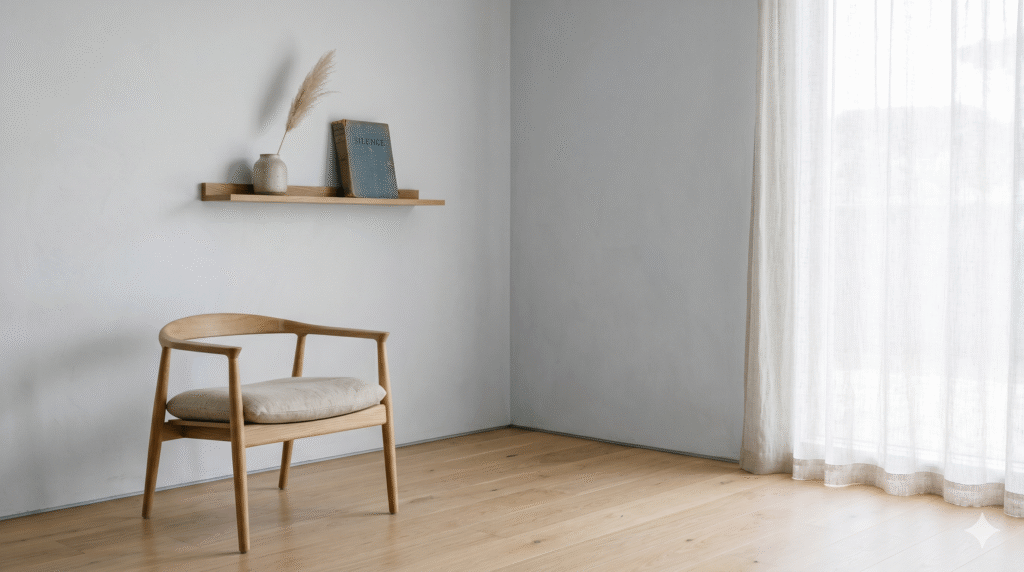
What actually creates the feeling of space is visual silence. It is the discipline of having fewer things in view, positioned with intention, in a palette that allows the eye to rest. A well-edited small room does not look small. It looks considered. And that consideration, paradoxically, is what makes it feel generous.
Every guide, idea, and solution in this category begins from the same premise: edit first, acquire second. Before you buy a mirror to make the room look bigger, ask what you might remove to achieve the same effect — at no cost at all. That shift in thinking is where a good small-space home begins.

- Every piece earns its place — or it doesn't stay
- Storage that shows is storage that costs you visually
- Colour does more spatial work than furniture ever will
- A clear floor reads as a generous room, every time
- One considered object outperforms ten decorative ones
- The goal is calm — not clever, not full, not impressive
- Featured Solutions
Start here. The small space solutions that move the needle most.
Each one is built around a specific space, a specific problem, and a specific budget — with before-and-after clarity on exactly what changes and why it works.
STUDIO & 1 BHK
The Mirror Strategy That Actually Works
Not every mirror placement creates the illusion of depth. This guide covers the exact positions, sizes, and frame styles that expand a room visually — and the common mistakes that make it worse.
Budget
Time
Skill
₹800 – 2,500
Under 2 hours
No Tools Needed
ANY ROOM
Light Paint, Dark Ceiling: The Rule Worth Breaking
The conventional wisdom — paint it white to make it bigger — is only half the story. A darker ceiling, used correctly, draws the eye up and creates the vertical height a small room desperately needs.
Budget
Time
Skill
₹600 – 1,400
Half A Day
Basic Painting
LIVING ROOM
Furniture on Legs: Why It Changes Everything
A sofa that sits directly on the floor creates a visual barrier. One raised on slim legs allows light to pass beneath it — and that strip of visible floor makes the entire room read as larger. This guide covers what to look for, what to avoid, and how to add legs to furniture you already own.
Budget
Time
Skill
₹300 – 900
Under 1 hour
Beginner DIY
BEDROOM
The Case for Concealed Storage
Open shelving looks appealing in photographs. In a small bedroom, it is one of the fastest ways to make a space feel chaotic. This guide walks through affordable concealed storage solutions — and how to transition from open to closed without buying new furniture.
Budget
Time
Skill
₹500 – 2000
Weekend
No Tools Needed
KITCHEN & DINING
Lighting Zones in a Single Room
In a compact open-plan space, lighting is the only tool that lets you define zones without walls. This guide covers affordable layered lighting setups — ambient, task, and accent — that make a studio or 1 BHK feel like it has distinct, purposeful areas.
Budget
Time
Skill
₹1000 – 3,500
Afternoon
No Wiring Needed
ENTRYWAY & HALLWAY
A Considered Entryway in Under 60 cm
The entryway sets the entire tone of a home. In a small apartment, it is often a single wall — or less. This guide shows how to create genuine arrival: a hook, a tray, one considered object, and a surface that tells you this home was thought about.
Budget
Time
Skill
₹400 – 1,200
1-2 hours
Beginner
-THE PRINCIPLES
What every small space gets right when it works.
These are not decorating tips. They are the underlying logic that separates a small room that feels stifling from one that feels like enough.
I
The floor is the most powerful surface in the room.
A clear floor reads as space. Every item placed on it — a bag, a pair of shoes, a stray chair — reduces the perceived square footage more than any wall treatment could add back. Keep the floor as empty as possible, and the room will feel at least a third larger than it is.
II
Visual weight matters more than physical size.
A slim sofa with tapered legs takes up the same footprint as a bulky sectional but reads as half the size. Choose furniture with lower visual mass: open bases, slim profiles, transparent materials like glass or acrylic. The room responds to what the eye perceives, not what the tape measure confirms.
III
Vertical space is almost always underused.
In a small room, the wall above eye level is one of the most valuable and consistently neglected areas. Shelving, hooks, and hanging storage placed high draw the gaze upward, create the impression of height, and free the lower half of the room entirely.
IV
Repetition creates calm. Variety creates noise.
Choose two or three materials and repeat them throughout the space. One wood tone, one metal finish, one textile texture. Restraint in material palette is what distinguishes a designed small room from a collected one — and calm is what you are trying to achieve.
V
Natural light is not a luxury — it is the strategy.
Nothing opens a small room like unobstructed daylight. Keep window ledges clear. Use sheer rather than heavy curtains. Hang them high and wide, above and beyond the frame. The investment is almost zero; the impact on how the room feels is substantial.
-THE ZERO CLUTTER AUDIT
Before you add anything, read this.
The most transformative thing you can do in a small space costs nothing. It is the audit — a clear-eyed assessment of what is earning its place and what is simply occupying it.
* CONSIDER REMOVING
- Open shelving that displays items you don’t actively love or use daily
- Multiple small decorative objects that compete for attention instead of complementing each other
- Rugs that are too small — they fragment the floor and make rooms feel choppy
- Furniture that serves only one function and occupies significant floor space
- Floor-length curtains in a dark colour that absorb light rather than invite it
- Anything stored on worksurfaces that could live in a drawer or basket instead
- Artwork hung too low, which anchors the eye to the floor rather than lifting it
WORTH INVESTING IN
- One large mirror in the right position — it genuinely doubles perceived depth
- Storage ottomans or benches that conceal what they hold
- A single, correctly-sized rug that anchors all the furniture within it
- Curtains hung from ceiling height, in a fabric that lets light through
- Warm-toned bulbs — they shift the mood of a small room completely
- Baskets and lidded boxes that contain clutter without displaying it
“A small home, edited with care, is not a lesser home. It is simply one where everything present was chosen.“
– Ramya, Loamlet