
10 Budget-Friendly Living Room Makeover Ideas for 2026
Transform your space with intention, not expense — a practical guide to executing a beautiful budget living room makeover that feels calm and curated.
A beautiful living room has very little to do with how much you spend. The most striking homes in 2026 aren’t the ones filled with the newest furniture – they’re the ones that feel considered. Warm, edited, textured, and unmistakably personal.
The shift this year is away from buying more and toward choosing better. A single rearranged corner, a softer paint tone, or a thoughtfully styled coffee table can shift a room more dramatically than an expensive new sofa ever could.
Whether you’re working with a compact rental, a small apartment, or a busy family home that’s lost its spark, the ten ideas below are designed to deliver the biggest visual change for the smallest possible outlay. (Where I mention prices, I’ve used Indian Rupees, but the principles work in any currency.)
Let’s begin where every great makeover should — not with a purchase, but with an edit.
1. Start With a 'Less But Better' Edit
Before you buy a single thing, take everything out that no longer earns its place. A living room usually feels tired not because it lacks decor, but because too many things are competing for attention at once.
Clear your surfaces, remove duplicates, and keep only what is genuinely useful, beautiful, or meaningful to you. The result is immediate: the room reads as calmer and more deliberate, the way a well-photographed interior does.
Focus your edit on three areas:
- Coffee table clutter – old magazines, scattered remotes, stray trays, and one too many candles.
- Visual noise – mismatched cushions, tangled cables, and shelves packed to the edge.
- Furniture that blocks flow – extra side tables, stools, or storage that interrupts how you move through the room.
Once the space can breathe, every remaining piece looks more intentional. This is the foundation of the 2026 living room.
Budget tip: This step costs nothing. Always shop your own home before you shop online – you’ll be surprised what reappears once the clutter is gone.
2. Refresh the Room With a 2026 Color Palette
Paint remains the single most cost-effective way to transform a room. For 2026, palettes are moving toward soft, grounding, nature-led tones – and away from both stark white and the cold greys that dominated the last decade.
Think shades that feel restful without being dull: warm ivory, mushroom beige, muted olive, clay, dusty rose, soft taupe, greige, and deep brown as an accent.
A full repaint changes everything, but you don’t need one to see results. If your budget is tight, use color strategically instead:
- Paint a single accent wall behind the sofa or media unit.
- Refinish an old cabinet in olive, charcoal, or warm cream.
- Apply peel-and-stick wallpaper for a renter-friendly focal point.
- Create painted arches or panels for architectural interest — no construction required.
For a cohesive, expensive-feeling result, restrain your palette to three tones: one main neutral, one secondary, and one accent.
| Base Color | Secondary Tone | Accent Shade |
|---|---|---|
| Warm ivory | Mushroom beige | Olive green |
| Soft greige | Clay | Matte black |
| Cream | Natural wood | Dusty rose |
| Taupe | Linen white | Deep chocolate |
Pro tip: Choose a matte or eggshell finish for walls rather than gloss. It hides imperfections, diffuses light softly, and instantly looks more refined.
3. Rearrange the Furniture for Better Flow
A makeover doesn’t always require new furniture. Often the biggest change comes from simply moving what you already own.
Good placement supports three things: conversation, comfort, and easy movement. If a room feels cramped or visually heavy, the layout – not the furniture – is usually the problem.
Start with one question: where does your eye land when you walk in? Every room needs one clear focal point — a window, a piece of art, a bookshelf, or the sofa arrangement itself.
A few reliable layout upgrades:
- Float your furniture. Pull pieces a few inches off the walls so the room feels designed rather than lined up.
- Angle a chair toward the sofa to create a natural conversation zone.
- Protect your walkways. Leave roughly 75–90 cm of clear path around seating and tables.
- Anchor seating with a rug, especially in open-plan spaces.
- Never block a window. Natural light is the most luxurious feature any room has, and it’s free.
In smaller rooms, lean into visual lightness: slim-legged tables, low-profile seating, mirrors to bounce light, and wall-mounted shelves to keep the floor open.
Designer note: The most expensive-looking rooms share one quality — every piece feels deliberately placed, never pushed wherever it happened to fit.
4. Upgrade Cushions, Throws, and Soft Furnishings
Textiles are the fastest route to a current-looking living room. In 2026, the most elegant spaces favor texture over pattern.
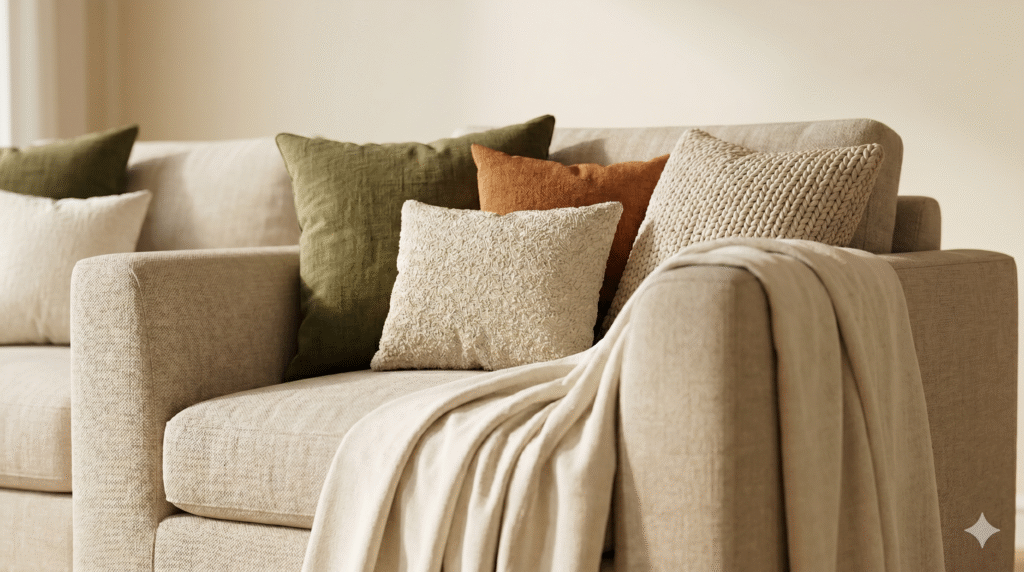
Rather than crowding your sofa with bright printed cushions, layer materials instead – bouclé, linen, cotton, velvet, jute, and chunky knits. They add depth and tactility while keeping the overall scheme calm.
| Sofa Type | Cushion Palette | Texture Pairing |
|---|---|---|
| Grey sofa | Cream, taupe, black | Linen and bouclé |
| Beige sofa | Olive, rust, ivory | Cotton and woven |
| Brown sofa | Cream, clay, mustard | Velvet and knit |
| White sofa | Sand, sage, charcoal | Slub cotton and jute |
Use fewer cushions, but choose them well – two to four considered ones look far more refined than eight mismatched. Drape a throw casually over one arm or across the backrest, and reach for earthy, natural fabrics rather than shiny synthetics.
Budget tip: Don’t buy new inserts. Buy covers only and reuse the cushion pads you already own — a complete refresh for a fraction of the cost.
5. Create a Statement Wall Without Expensive Art
Large artwork elevates a room instantly, but originals are costly. The good news: a striking wall can be built on almost any budget.
The 2026 approach to art is personal, imperfect, and collected – not generic and mass-produced. Your wall should look like it belongs to you and no one else.
Affordable ways to get there:
- Frame fabric scraps, block prints, scarves, or handmade paper.
- Make your own abstract canvas with leftover paint.
- Print black-and-white family photographs in matching frames.
- Use thrifted frames painted a single shared color for a cohesive gallery wall.
- Hang a woven basket, ceramic plate, or textile as sculptural wall decor.
If you want a boutique feel, go big. One oversized piece above the sofa reads as far more expensive than a scatter of small frames. For gallery walls, keep one element consistent – frame color, matting, photo style, or spacing – to stop the arrangement looking chaotic.
Under ₹1,000 idea: Buy a plain canvas board, layer two or three tones of leftover wall paint into a soft abstract composition, and finish it with thin wooden trim for a custom-framed look.
6. Style the Coffee Table Like a Designer
A coffee table can be the quiet centerpiece of the whole room – but only when it’s styled with intention rather than piled with stuff.
Use the classic stylist’s formula: height, texture, shape, and negative space. Begin with a base layer — a tray or a large book. Add one vertical element, like a vase or candle holder. Then introduce a single natural texture: a small bowl, a stone object, a strand of wooden beads, or a ceramic dish.
| Element | Budget Option |
|---|---|
| Base | Tray, hardback book, woven mat |
| Height | Vase, candle holder, small plant |
| Texture | Ceramic bowl, wooden object, stone coaster |
| Personal touch | Handmade piece, small framed photo, travel find |
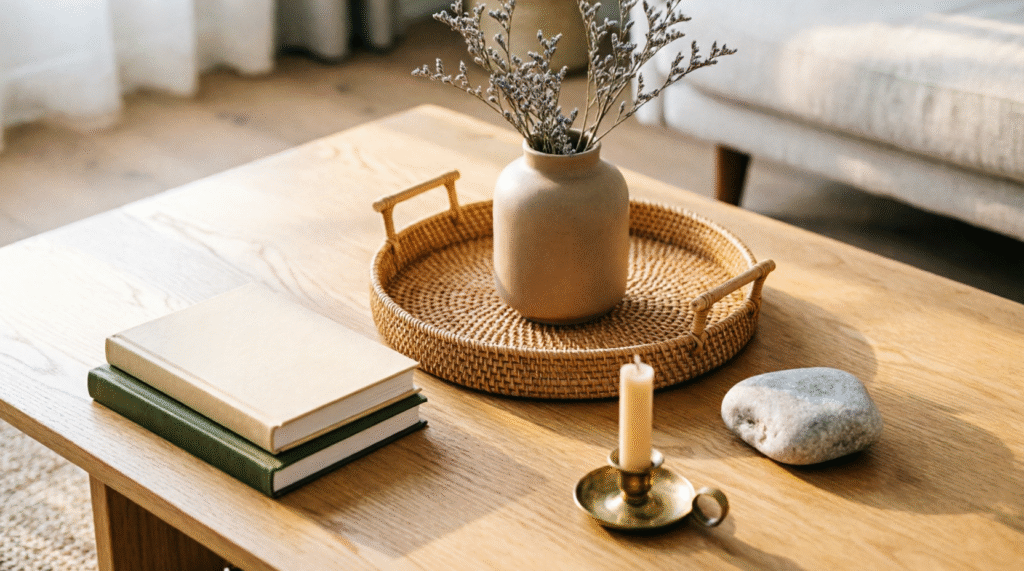
Leave at least a third of the surface empty. That breathing room is what separates “styled” from “cluttered.”
Designer tip: Group objects in odd numbers. A trio almost always feels more balanced and natural than a pair.
7. Add Warm, Layered Lighting
Few things change a room’s mood as completely as lighting. A single overhead light flattens a space; layered light gives it warmth and depth.
Aim for three levels:
- Ambient – overall brightness for the room.
- Task – focused light for reading or working.
- Accent – low, atmospheric light for mood.
None of this requires expensive fixtures. A floor lamp beside the sofa, a table lamp on a side table, and a warm LED strip tucked behind a shelf or media unit will do the work of a far pricier scheme.
Crucially, choose warm white bulbs (around 2,700K) over cool white. Warm light makes wood, fabric, and wall color look noticeably richer.
Affordable upgrades to consider:
- Plug-in wall sconces instead of hardwired fittings.
- Rechargeable lamps for corners with no nearby socket.
- Paper lantern pendants for soft, sculptural light.
- Hidden LED strips for a gentle ambient glow.
- Thrifted lamp bases refreshed with new shades.
A well-lit room feels considered and expensive, even when the furniture itself is simple.
8. Bring in Organic Greenery
Plants remain one of the easiest ways to soften a room and make it feel alive. In 2026, greenery is being used more thoughtfully – fewer plants, better placed, with sculptural forms doing the heavy lifting.
Rather than dotting pots in every corner, choose one or two statement plants and treat them as decor.
| Plant | Why It Works |
|---|---|
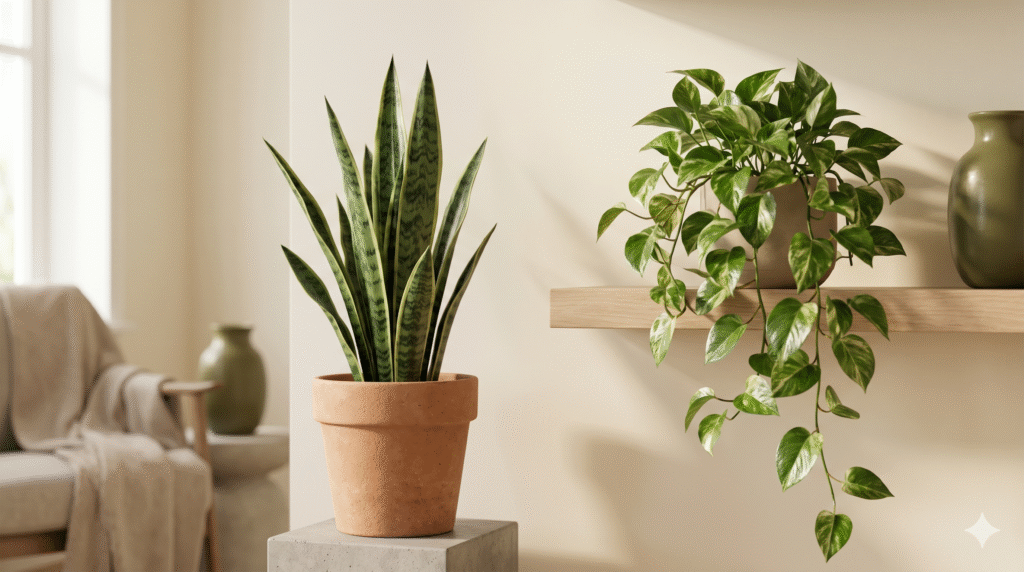
| Snake plant | Low maintenance and architectural |
| Pothos | Ideal for shelves and trailing corners |
| Areca palm | Adds height and softness |
| Rubber plant | Glossy leaves, distinctly modern |
| ZZ plant | Forgiving and beginner-friendly |
Tie plants into your palette with baskets, terracotta, or simple matte ceramic planters. If natural light is limited, a single tall vase of realistic faux branches reads as far more refined than several small artificial plants.
Budget tip: Propagate from cuttings or swap with friends. It costs nothing and gives your decor a personal backstory.
9. Upgrade Old Furniture With Small DIY Details
You rarely need to replace furniture to make it feel new. Targeted upgrades can turn a basic or dated piece into something that looks custom-made.
Focus on items with good structure but tired finishes – media units, side tables, bookshelves, stools, and cabinets.
Worthwhile, low-cost upgrades:
- Swap out cabinet and drawer hardware.
- Repaint in matte black, warm white, olive, or mushroom.
- Add cane webbing to cabinet doors for natural texture.
- Apply peel-and-stick wood film to tabletops or shelves.
- Attach fluted trim to a plain console for a high-end profile.
- Replace cheap legs with tapered wooden or metal ones.
The 2026 look rewards furniture that feels crafted and tactile. Even a plain sideboard can look considered with new handles, a calm color, and careful styling.
Under ₹1,000 idea: Refresh a basic cabinet with new knobs, a coat of leftover paint, and a strip of peel-and-stick wallpaper lining the inside shelves.
10. Finish With Scent, Sound, and Personal Details
A makeover isn’t only visual. The rooms we remember are the ones that feel good to be in – warm, personal, and full of small sensory cues.
Add finishing touches that reflect how you actually live, rather than copying a showroom:
- A signature scent – sandalwood, citrus, vanilla, jasmine, or cedar.
- A discreet sound corner – a small speaker styled neatly on a shelf.
- A personal object – a handmade bowl, a travel find, an heirloom textile, a framed note.
- A reading basket – two or three current books or magazines within reach.
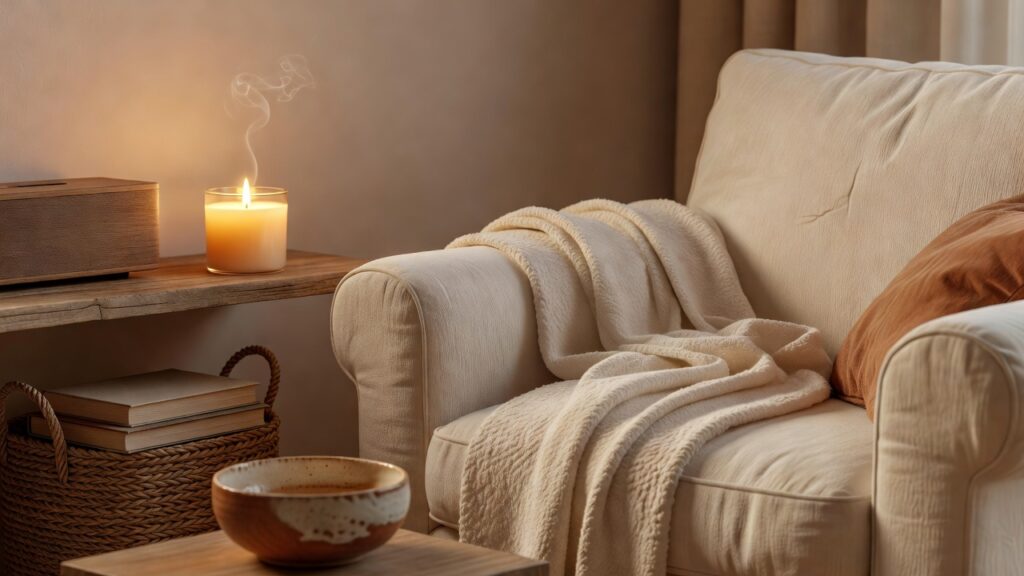
- An evening ritual – a candle, a lamp, and a throw beside your favorite seat.
These details give a room its soul. They’re what make a space feel lived-in rather than staged.
Real luxury isn’t marble and designer labels. It’s a room that feels calm, intentional, and unmistakably yours.
Your Budget Living Room Makeover Checklist
Work through these in order before spending on anything new – the free steps alone will transform most rooms.
| Step | What to Do | Cost Level |
|---|---|---|
| 1 | Declutter and edit surfaces | Free |
| 2 | Rearrange furniture for better flow | Free |
| 3 | Choose a simple three-tone palette | Free-Low |
| 4 | Swap cushion covers and add a throw | Low |
| 5 | Create DIY or thrifted wall art | Low |
| 6 | Style the coffee table with intention | Free-Low |
| 7 | Add warm, layered lighting | Low-Medium |
| 8 | Bring in one or two statement plants | Low |
| 9 | Refresh old furniture with paint or hardware | Low |
| 10 | Add personal sensory details | Free-Low |
Frequently Asked Questions
How much should a budget living room makeover cost?
Many of the highest-impact changes – decluttering, rearranging, restyling – cost nothing at all. With a modest budget for paint, cushion covers, a lamp, and a plant, most rooms can be transformed for a fraction of the price of a single new sofa.
What are the living room color trends for 2026?
Soft, nature-inspired tones lead the way: warm ivory, mushroom beige, muted olive, clay, dusty rose, and greige, with deep brown or matte black as an accent. Stark white and cold grey are fading out.
What's the single most effective budget change?
Editing and rearranging what you already own. It costs nothing and almost always delivers the biggest visual shift before you spend a rupee.
Final Thoughts
A budget-friendly makeover isn’t about making your home look expensive for its own sake. It’s about creating a space that feels peaceful, practical, and personal.
The strongest living room trends of 2026 aren’t about excess at all. They’re about restraint, warmth, comfort, texture, and individuality. By editing what you own, choosing a calm palette, improving your layout, layering your lighting, and adding a few thoughtful handmade details, you can build a living room that feels genuinely high-end – without the high-end price tag.
Your dream living room isn’t out of reach. With a little creativity and intention, it’s closer than you think.